Brandon Walker
Day of the DeadBrandon Walker is a former Pima County sheriff whose retirement does not end his work so much as change its terms. Drawn into The Last Chance and the unresolved murder of Roseanne Orozco, he brings investigative experience to a case that official systems failed to pursue adequately. His renewed purpose depends not only on evidence and persistence, but also on learning when to listen, respecting the people whose past is under examination, and accepting that he is no longer acting with a sheriff’s authority.
Identity and Return to Work
An early glimpse of Brandon’s life after the sheriff’s office catches him before a formal event, struggling with the strings of a bow tie in front of a bathroom mirror. The starched white shirt and tuxedo feel like an awkward replacement for his former dress uniform: as sheriff, he could have attended such gatherings in the clothes of his office. The scene establishes a man who still measures himself against a public role he has left behind, even in an ordinary moment of preparation.
At sixty-one, Brandon has also begun to reckon with physical limits. In April, he swims in a heated lap pool without timing himself or counting laps. He stops when he can no longer continue, aiming to maintain endurance rather than set records. His right hip and left knee have recently troubled him, making the warmth of the water especially welcome. The routine is modest and unspectacular, but it gives concrete form to the distinction between staying capable and pretending to be young.
His return to investigative work begins with a decision he makes quickly: after hearing about The Last Chance, he tells Ralph Ames he is in and asks him to pass on that he owes G. T. Farrell. Six months later, he has concluded that joining Ralph and the organization was not a mistake. It has given him back both his life and his sense of purpose. Fat Crack Ortiz then entrusts him with a case that needs to be carried into and through The Last Chance, turning that renewed purpose into a particular responsibility.
Working with the Community
Brandon’s approach is shaped by long experience among the Tohono O’odham Nation. He knows that direct questions can be regarded as impolite, and in one conversation he limits himself to a single observation rather than press Emma Orozco with a question. He watches her reflection in an entryway mirror instead of looking straight at her. The gesture is not merely a mannerism: he is trying to make room for her to speak without requiring her to answer on his terms.
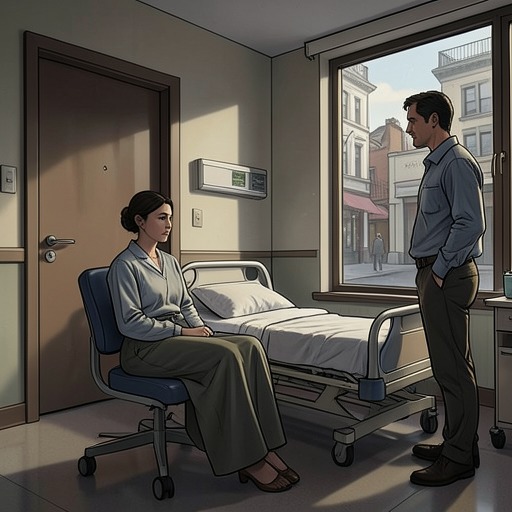
He recognizes the difficulty of Emma’s decision to revisit the past in front of a stranger and a white man. She grips the handle of her walker as she speaks, a support that helps her stand and, in Brandon’s reading of the moment, also reflects the effort required to go against a lifetime of teaching and longstanding tradition. His attention to that effort informs how he conducts the inquiry: Emma is not simply a source of information but a person taking a risk by bringing a painful history into the room.
Brandon explains that The Last Chance is a private organization founded several years earlier by Hedda Brinker, whose daughter was murdered in 1959. He presents it as an alternative route for a case whose history is entangled with questions of jurisdiction and institutional neglect. Roseanne’s presumed murder on the reservation was understood to fall within the responsibilities of the FBI or local tribal police, unlike the off-reservation murder of Gina Antone, which came under the Pima County Sheriff’s Department. The difference in jurisdiction helps explain the investigative context; it does not establish what happened to Roseanne or who killed her.
Reopening Roseanne Orozco’s Case
Brandon follows Emma’s lead and takes the old case seriously. Her account of the hospital records is precise: staff found records for Emma’s three admissions, including those connected with Andrea Tashquinth’s birth and Roseanne’s birth, as well as Emma’s later hysterectomy, but no record of Roseanne ever being admitted. Emma rejects the suggestion that the records might simply have been lost. The discrepancy gives Brandon a reason to examine the hospital history rather than accept the absence of a file as proof that Roseanne was never there.
He remembers that a study funded by Arizona State University in the early 1990s had put existing health records from the Sells Indian Health Services Hospital into computers. The records extended back to the 1950s and were used to compare longevity and track causes of death. Brandon recalls that the study, together with money from tribal casino operations, was among the reasons the hospital later had its own kidney dialysis center. For the investigation, this history matters because it suggests that old medical records may have existed in a form worth searching, even when a later inquiry reports that Roseanne’s admission cannot be found.
The case also requires him to revisit the assumptions made when Roseanne was killed. He recalls that the original leading theory focused on the father of her unborn child. With no known boyfriend, investigators suspected incest and considered her father, Henry Orozco, responsible. Brandon questions how persuasive that theory was, noting that Roseanne had undergone an appendectomy four months before the murder and that the number of murderers in Pima County at the time was limited. Those details prompt renewed scrutiny; they are not, by themselves, proof of Henry’s guilt or anyone else’s.
A second line of inquiry comes from Andrea’s memories of the day Roseanne stopped speaking. As children, the sisters went to school together after Andrea persuaded their grandmother to let Roseanne accompany her. Andrea recalls that Roseanne’s face was wet with tears at the end of the day and that she never spoke again—not to Andrea, their parents, or people at school. Later, Andrea says she had tried to tell investigators that what happened to Roseanne had to have occurred at the hospital, but nobody listened. She had been sixteen, and her opinions had not been taken seriously. Brandon writes a reminder in his notebook. The recollection does not settle what happened, but it gives him a lead that the original investigation had not meaningfully pursued.
Brandon’s effort to locate Roseanne’s hospital history develops alongside Emma’s determination to act. Emma reveals that she, her grandson, and Sam dug up the remains after dark rather than wait to seek permission from the tribal council, a process she believed would take too long. Brandon’s role in the case therefore sits beside, but is not identical to, the family’s decision: he is investigating the murder, while Emma and her relatives have taken a consequential step concerning the remains. The episode makes clear that the search for evidence involves community authority as well as the urgency of an old case.
Loyalty, Grief, and Responsibility
Fat Crack Ortiz gives Brandon a way to understand how the case connects to other acts of care. He compares Delia’s mother saving her and his own role in bringing her home with Brandon and Diana Ladd helping Lani and giving her back to the People. He then tells Brandon that I’itoi has chosen him to speak for Roseanne. The charge is spiritual as well as investigative: Brandon is being asked to carry a story that others were unable or unwilling to hear.
Fat Crack’s death weighs heavily on him. Outside a supermarket, Brandon waits for Andrea Tashquinth to finish work, thinking about the loss and about how repeated bereavement has never made the next loss easier. His grief does not displace his work, but it changes its emotional register. The investigation is no longer only a professional challenge or a chance to recover purpose; it is also bound to the responsibilities Fat Crack placed in his hands.
Confrontation and Survival
Brandon understands that pursuing the case may put his family at risk. He tells Ralph Ames that he may have found Roseanne’s killer, but that the man knows Brandon, knows his family, and knows where they live. He asks for backup because he wants the suspected man caught before he can evade them. The concern is practical and personal at once: the case has moved from old records and testimony into a danger Brandon believes is immediate.
When a Lexus pulls back onto the highway, Brandon uses the bulk of his Suburban to force it onto the shoulder. He then discovers that its driver is Gayle Stryker, not Larry Stryker. Although common sense would counsel waiting with his vehicle for help, Brandon recognizes that this is personal: Gayle had tried to kill him, and he is determined to pursue her. He runs through a grove of eucalyptus, slows when he becomes winded, and fires five shots. He then collapses, believing Gayle has hit him after all.
Brandon survives a heart attack. Brian Fellows and Arizona Department of Public Safety officer Cassie Downs find him; Downs has a defibrillator in her patrol car and gets his heart beating again. A helicopter already at the scene for the gravel-truck accident takes Brandon to the hospital. A woman in a Honda does not survive the crash. When told he had been lucky, Brandon does not regard the outcome in those terms: his attention remains on the Strykers. His ending preserves the tension that has defined his return to work—he has recovered a purpose, but his body and his adversaries impose limits he cannot simply will away.